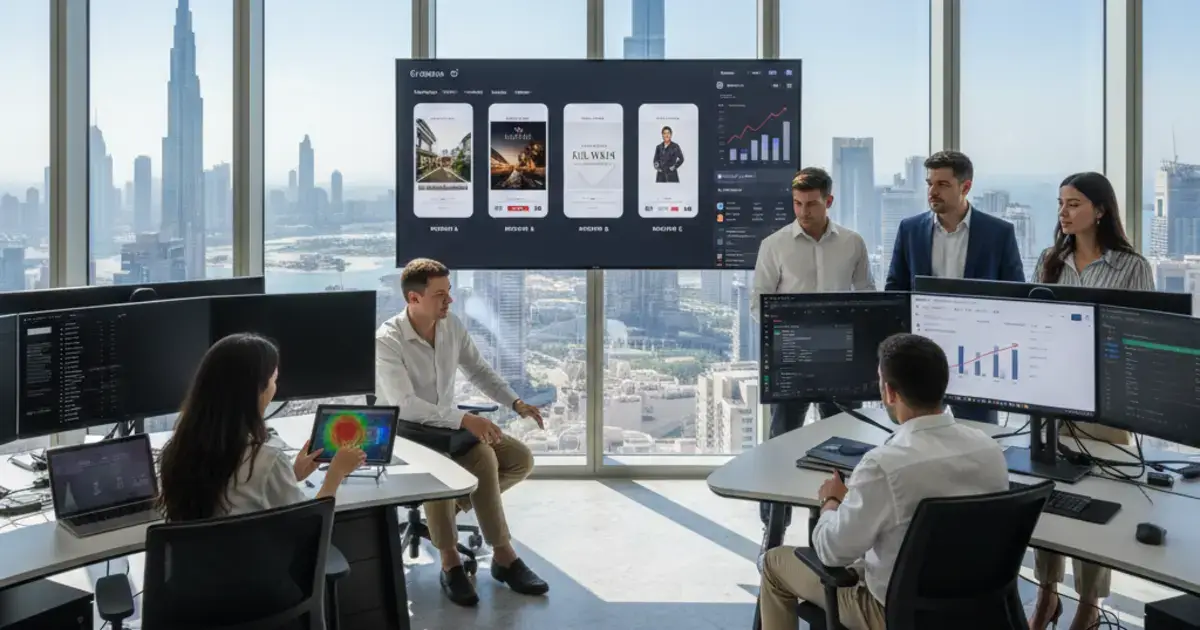

Effective creative testing in targeted ads for Facebook and Instagram in Dubai is a key success factor, allowing you to optimize your ad budget and significantly boost ROI. In the highly competitive UAE market, a systematic approach to A/B testing different ad elements, from images to text, helps identify the options that resonate best with your target audience and scale successful campaigns to achieve maximum business results.
Quick Overview
- Systematic A/B testing of creatives is crucial for saving budget and boosting ROI in Dubai.
- The key to success is a clear hypothesis, testing one element at a time, and analyzing relevant metrics (CTR, CPL, CPA).
- Consider the cultural specifics and multilingual audience of the UAE when creating and testing creatives.
- Video and interactive formats often show better engagement in the Emirates but require validation.
- Avoid common mistakes: too small a budget, ignoring data, and frequently changing hypotheses.
Why Is Creative Testing Vital in the Dubai Market?
In Dubai’s competitive market, where the cost of ad impressions and clicks can be significantly higher than in other regions, every dirham of your budget needs to work as efficiently as possible. Creative testing isn’t just an option; it’s a necessity for any business aiming for measurable results. Without systematic testing, you risk wasting your budget on ineffective ads that don’t capture the local audience’s attention.

In our experience with a client in Dubai, specializing in luxury real estate, we managed to reduce the cost per lead by 45% in just three weeks. We systematically tested various visual concepts and textual formulations, adapting them to the preferences of both expats and local residents. This was a direct result of smart testing, where we initially allocated about 25% of the budget for tests.
What is A/B Testing for Creatives and Its Principles?
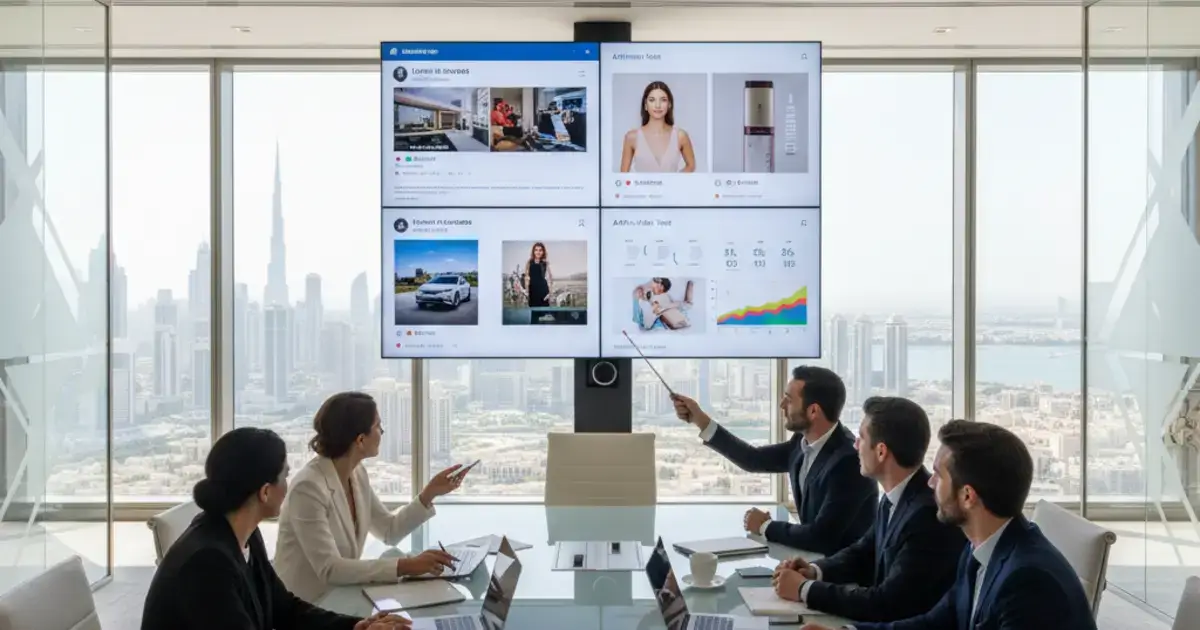
A/B testing for creatives is a method of comparing two or more versions of an ad to determine which one performs better. The main principle is to change only one element between versions to accurately understand what specifically impacted the result.
Imagine you want to understand which headline grabs more attention. You create two absolutely identical ads but with different headlines (Version A and Version B), show them to the same audience, and then compare key metrics like CTR (Click-Through Rate) or CPL (Cost Per Lead). This helps avoid false conclusions caused by multiple changes.
- Control and Variant: There should always be a control version (original) and one or more test versions (variants).
- One changeable element: Change only one parameter at a time – headline, image, call to action.
- Identical audience: Both versions should be shown to the same or a statistically similar audience.
- Sufficient data volume: A certain number of impressions and conversions are required to obtain statistically significant results.
How We Structure Creative Testing for Facebook and Instagram in Dubai?
A structured approach to testing guarantees valuable insights, not just random data. My experience in the UAE market has shown that without a clear plan, it’s easy to get lost in metrics and waste your budget.

Step 1: Defining the Goal and Hypothesis
Before launching a test, clearly state what you want to check and why. For example: “We hypothesize that video creatives featuring happy families against the backdrop of Dubai Marina will generate a lower CPL for residential complexes than static images, because video better conveys atmosphere and emotional connection to a place.”
Goals can vary:
- Increase CTR by 15%.
- Reduce CPL by 20%.
- Increase the number of applications.
- Boost brand awareness in Dubai. (In this context, it’s useful to learn how to promote a brand in the UAE.)
Step 2: Choosing the Audience and Placements
For creative testing, it’s crucial to select the most relevant target audience. Use precise Facebook and Instagram targeting settings, considering demographics, interests, behavior, and geolocation (e.g., Dubai, Abu Dhabi, Sharjah). Placements (Facebook Feed, Instagram Stories, Reels) can also affect how a creative is perceived, so sometimes it’s worth testing creatives across different placements.
Step 3: Creative Development
Based on your hypothesis, create several versions of the creative. Remember the rule: one change at a time. If you’re testing headlines, everything else (image, text, CTA) should be identical. If you’re testing images, the headline and text should be identical.
Types of creatives to test:
- Images: High-quality photos, infographics, collages.
- Videos: Short clips (15-60 seconds), animations, stories.
- Carousel: Multiple images or videos in one ad.
- Stories: Vertical videos or images designed for quick viewing.
Working with clients in Dubai, we’ve noticed that video creatives with movement and dynamism perform exceptionally well for services and entertainment, sometimes yielding 1.5-2 times higher CTR compared to static images, provided they are high-quality and adapted for mobile devices. However, for more conservative niches, like legal services, informative static banners often get a better response.
Step 4: Campaign Setup and Launch
In the Facebook ad account, set up a campaign with the A/B testing feature or manually create several ad sets with identical targeting settings and different creatives. Ensure the budget is distributed evenly or appropriately for the test goals.
- Budget: Allocate a sufficient budget so that each version receives the necessary volume of impressions (at least $50-100 per creative to start, depending on the niche in the UAE).
- Duration: At least 3-7 days to gather enough data and smooth out daily fluctuations.
Step 5: Analyzing Results and Scaling
After the test is complete, carefully analyze the data. Look not only at CTR but also at conversions (leads, sales), cost per result (CPL, CPA), and ROI. Sometimes a creative with a high CTR might yield low conversions, and vice versa.
Based on our campaigns in the UAE, we often see that the creative with the highest CTR isn’t always the most converting one. For instance, we once tested a bright, eye-catching banner for a clothing store in Dubai. It showed a CTR of 3%, which was twice the average, but the CPL was 30% more expensive than a calmer banner with a clearly formulated unique selling proposition (USP) and a CTR of 1.5%. This once again highlights the importance of end-to-end analytics and tracking target actions. In such situations, many make mistakes that kill their ad budget in the UAE.
After determining the winner, scale it by allocating a larger budget, or use the insights gained to create new creatives.
Insight: The most clickable creative doesn’t always bring the most profit. Always analyze final business metrics, not just intermediate ones.
How Does the Specificity of the UAE Market Affect Creative Testing?
The UAE market is unique and requires a special approach to advertising. What works in Europe or the USA might be completely ineffective in Dubai or Abu Dhabi.
Cultural Sensitivity and Local Traditions
The UAE is a Muslim country with strong cultural traditions. Creatives must be respectful, avoiding controversial images or statements that could be perceived negatively. For example, images of revealing clothing, alcohol displays, or certain gestures might be unacceptable. Analyzing projects in the Emirates shows that creatives reflecting family values, luxury, achievements, and technological advancement often resonate best.
Dubai’s Multilingual Audience
Dubai is a city of expats. Arabic, English, Hindi, Urdu, Tagalog, and many other languages are spoken here. It’s important to test creatives in different languages to understand which language or combination of languages (e.g., English with Arabic inserts) works best for your target audience. In our practice, for many niches, English text in creatives provides broad reach, but for certain services or products aimed at the local population, Arabic shows significantly higher conversion rates.
Behavioral Characteristics and Purchasing Power
Observations from the Dubai market show that the audience often values quality, exclusivity, and premium status. Creatives that emphasize these aspects can be more effective, especially for luxury goods and services. Additionally, locals and long-term expats often use specific platforms and media, which should also be considered. For example, using local influencers or recognizable locations in creatives can significantly boost trust.
What Typical Mistakes Kill Your Ad Budget When Testing Creatives in Dubai?
My many years of experience with targeted advertising in the UAE have revealed a number of recurring mistakes that cost companies significant money.

1. Insufficient Test Budget
Many entrepreneurs in Dubai want to “try out” with a minimal budget, say, $50 per campaign. This is insufficient to obtain statistically significant data, especially in highly competitive niches. Facebook and Instagram algorithms require time and budget for “learning” and adequate impression distribution. Too small a budget leads to unrepresentative results and false conclusions.
2. Testing Multiple Variables Simultaneously
This is a classic mistake. If you simultaneously change the image, headline, and call to action, you won’t be able to accurately determine what specifically led to the change in results. Always change only one element at a time. This is the only way you can identify which Facebook ad mistakes in the UAE lead to budget waste.
3. Ignoring UAE Cultural and Social Specifics
As I already mentioned, the UAE is a unique market. Using creatives designed for Western audiences without adapting them to local norms and traditions often leads to failure. Be careful with humor, images, and text to avoid causing negative reactions or complete indifference.
4. Too Short Testing Duration
Running a test for 1-2 days can yield misleading results due to fluctuations in audience activity on different days of the week or hours. As a rule, I recommend running tests for at least 3-7 days to gather sufficient data and account for all factors.
5. Focusing Only on CTR or CPM
A high CTR (click-through rate) doesn’t always mean a successful campaign. It’s important to look at metrics that directly impact your business: CPL (cost per lead), CPA (cost per acquisition), CR (conversion rate). A creative might be very clickable, but if it attracts the wrong audience, it only increases costs. This is especially relevant for niches where e-commerce marketing is crucial.
6. Lack of a Clear Hypothesis
Testing “just to see what happens” leads to chaotic results. Always start with a specific, measurable hypothesis. For example: “Changing the CTA button color from blue to green will increase the conversion rate by 5%.”
Practical Recommendations for Successful Creative Testing in Dubai
Based on my own experience, I can offer a few tips to help you maximize your testing effectiveness.
- Continuous Testing: The UAE market is dynamic; audience tastes and preferences change. What worked six months ago might not be relevant today. Always keep several test creatives in reserve.
- Using Broad Audiences Initially: Sometimes, to gather initial data and identify the most effective “creative-message” combinations, it makes sense to use broader audiences. After identifying winners, you can narrow down your targeting.
- Adapting to Placement Format: A creative for the Instagram feed should differ from a creative for Stories or Reels. Test native formats for each placement. For example, short, dynamic videos with quickly readable text work great for Stories.
- Leveraging User-Generated Content (UGC): In the UAE, as everywhere, people trust other people. UGC, if appropriately integrated and compliant with cultural norms, can show very good results.
- Automation and Third-Party Tools: For large-scale tests, consider using specialized tools for automated A/B testing or creative analysis tools. This can save time and improve accuracy.
- Focus on Value and USP: Clearly communicate the value of your offer. In Dubai, where competition is high, your unique selling proposition should be visible at first glance. Test different ways to convey it.
- Consult Experts: If you’re not confident in your abilities, it’s better to find an experienced targetologist in Dubai who has experience working in the region. This will save you much more money than trying it yourself.
For example, for one of our clients, a kindergarten in Dubai, we launched a campaign where the key strategy was active A/B testing of video creatives demonstrating children’s daily life at the institution. Thanks to this approach and continuous optimization, we achieved impressive results: 1284 leads with an average CPL of just $12.2. This is a vivid example of how systematic testing, focused on local specifics and behavioral patterns, can bring measurable success.
Frequently Asked Questions
How much does creative testing cost in Dubai?
The cost of testing heavily depends on your niche, competition, and audience scale. On average, to obtain statistically significant data for one ad group in Dubai, I would recommend a budget of $100 to $300 per creative over 3-7 days to get enough impressions and conversions for analysis.
How to choose the right audience for testing in the UAE?
Audience selection should be based on your ideal customer. Use detailed Facebook targeting: geolocation (Dubai, Abu Dhabi), demographic data (age, gender, marital status), interests (luxury brands, real estate, travel), and behavioral data (frequent travelers, expats). To start, you can take a broad but relevant audience and then narrow it down based on the data obtained.
When can I expect the first results from creative tests?
First insights can be obtained within 2-3 days of active ad delivery, but for making informed decisions, I recommend waiting at least 5-7 days. This allows Facebook and Instagram algorithms to complete their learning phase and gather enough data for statistical significance, mitigating fluctuations in audience behavior.
How does testing video creatives differ from static images?
Testing video creatives requires attention to retaining attention in the first few seconds, the presence of subtitles (many watch without sound), and a clear call to action. For static images, composition, quality, contrast, and message clarity are more important. Videos often yield higher engagement but are more expensive to produce, while images are easier to scale.
What metrics are important for evaluating creative effectiveness in the Emirates?
In the Emirates, as in other regions, key metrics include CTR (click-through rate), CPL (cost per lead) or CPA (cost per acquisition), CR (conversion rate), and ROI (return on investment). It’s important to track these metrics collectively to make decisions based on real business value, not just intermediate indicators. Relevance and uniqueness are also crucial in the context of competition in the Dubai market.
👉 Subscribe to my Telegram channel.
✉️ Message me on WhatsApp if you need clients.
📸 Follow updates on Instagram.