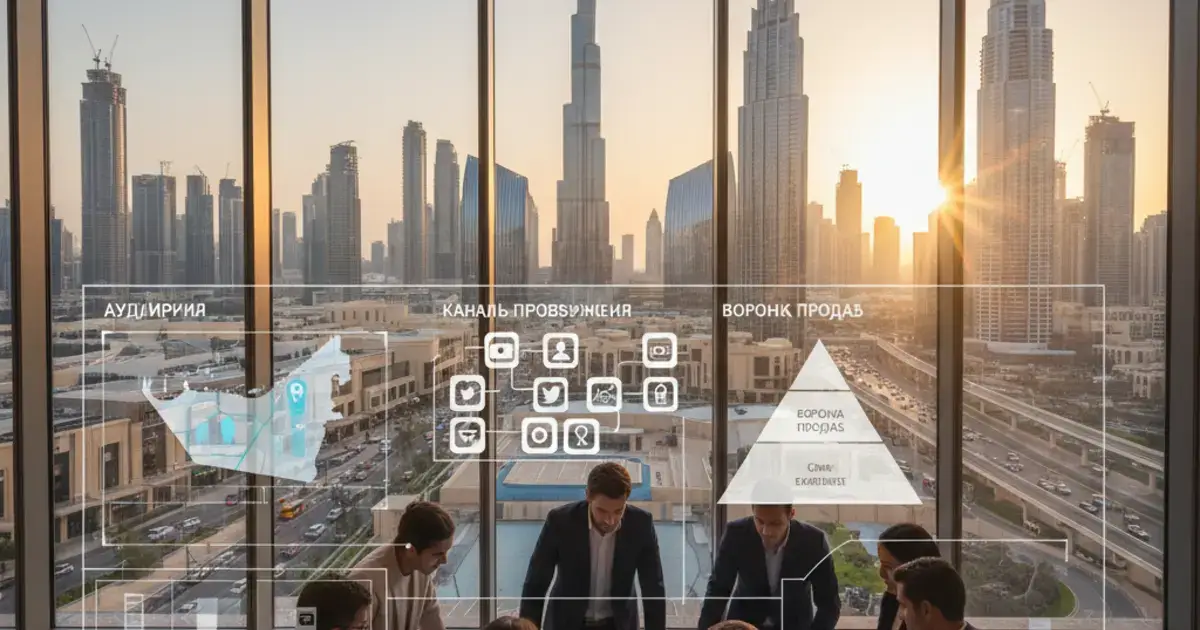

Operating in the UAE market — particularly in Dubai — demands a clear and well-considered promotion strategy. Before launching any advertising campaigns, it is essential to understand the audience’s characteristics, the competitive environment, and the specifics of running a business in this region. A strategic misstep at the outset costs far more than the time invested in getting it right: the Dubai market does not forgive template solutions or vague positioning.
Target Audience Analysis as the Foundation of a Dubai Strategy
The first and most critical stage of building a promotion strategy is deep target audience analysis. The Emirates are home to a multinational population: local residents, Arabic-speaking expats from other Gulf countries, the Russian-speaking diaspora, Indian and Pakistani communities, Europeans, and residents from Southeast Asia. This diversity makes segmentation not merely advisable but mandatory.
Audience segmentation parameters for the UAE market must include:
- age and gender — behavioral patterns and purchasing habits differ substantially across generations;
- nationality and language — the same product requires fundamentally different messaging for Arabic-speaking, Russian-speaking, and English-speaking audiences;
- income level and neighborhood — the Marina and JBR audience differs from residents of suburban areas in both purchasing power and media consumption;
- interests and behavior — Meta and Google’s digital tools enable targeting users across hundreds of behavioral profile parameters.
Based on project experience in Dubai, segmenting the audience into three to five clearly defined profiles with distinct offers and creatives for each reduces cost per lead by 30–40% compared to a single universal campaign. Tools for gathering audience data include website analytics, surveys of existing clients, ad account data, and competitive niche analysis.
How to Choose a Promotion Strategy in Dubai: Selecting Channels
Given the specifics of the audience, advertising channel selection must be deliberate — not universal. Trying to be everywhere on a limited budget is a direct path to spreading resources too thin and achieving weak results on every platform.
In the UAE market, the most effective promotion channels are:
- Social media (Facebook and Instagram). The primary tool for reaching a broad expat and younger audience. Instagram performs better for visually rich niches and audiences under 35; Facebook suits a more mature audience and B2B segments. A detailed breakdown of the platform choice in the Dubai context is covered in the article on Facebook vs. Instagram advertising for your Dubai business;
- Google Ads. Captures hot demand — users already searching for a specific product or service. Effective in niches with pronounced search demand: real estate, healthcare, education, legal services, and e-commerce;
- Targeted advertising in the UAE. Combining multiple platforms under a unified funnel logic delivers results that are multiples better than working with a single channel. Targeted advertising in the UAE is built on the intersection of audience data from multiple sources;
- Influencer marketing. Collaboration with local content creators is especially effective in consumer niches where social proof carries high weight: food, beauty, fitness, education, and lifestyle. The critical condition is that the influencer’s audience matches the business’s target customer profile;
- WhatsApp marketing. In the UAE, WhatsApp is the primary communication channel. A direct WhatsApp button on the landing page and fast response to incoming inquiries are non-negotiable elements of any sales funnel.
Building a Sales Funnel for a Business in Dubai
A sales funnel in Dubai operates on the same principles as in other markets, but with several important distinctions driven by local audience behavior. Decision-making speed among UAE audiences is often higher than in less competitive markets — but so is skepticism toward advertising claims.
The structure of an effective funnel for the Dubai market:
- Capturing attention. Bold, specific, and relevant content that stands out in an oversaturated advertising environment. Generic visuals and templated copy go unnoticed in Dubai — the audience simply scrolls past;
- Generating interest. A specific offer with measurable value: not “high quality,” but “consultation within 24 hours” or “cost estimate in 10 minutes”;
- Warming and engagement. Email marketing, WhatsApp broadcasts, and retargeting with educational content and social proof — consistent work with audiences that showed interest but didn’t yet take the target action;
- Conversion. The simplest and fastest possible target action: a single form with minimal fields, a direct WhatsApp button, and one clear next step.
Sales funnel automation in Dubai builds a sequence of touchpoints without manual involvement at every stage: instant responses, lead qualification, manager routing, and reminders about incomplete actions. One illustrative example of this logic in action is SMS and WhatsApp campaigns for recovering abandoned carts in e-commerce — a tool that consistently improves conversion in the UAE market.
Advertising Action Plan for the UAE: Structure and Key Elements
After defining the audience and selecting channels, the next step is developing a concrete advertising action plan with measurable objectives and clearly assigned responsibilities.
A complete promotion plan for the Dubai market includes:
- Specific and measurable goals. Not “increase sales,” but “generate 150 qualified inquiries per month at a CPL no higher than AED 80” or “achieve a 3:1 ROAS on Facebook by month three”;
- Budget allocation by channel and time period. Distribution must account for Dubai’s seasonality: December through February budgets should be higher than summer months across most consumer and B2B niches;
- A KPI system with a regular reporting cadence. CTR, CPL, lead-to-deal conversion, ROAS, and customer acquisition cost (CAC) — these metrics must be tracked weekly, not reviewed quarterly;
- Assigned owners with clear task boundaries. Who configures campaigns, who produces content, who handles incoming inquiries, and at what response speed.
A specific planning risk zone is budget overrun without predefined limits. Every campaign must have a maximum acceptable cost per lead, above which the campaign automatically pauses for analysis and adjustment. Effective advertising strategies in Dubai for your business treat exactly these budget protection mechanisms as a mandatory planning element.
Common Mistakes When Choosing a Promotion Strategy in Dubai
Across marketing strategy development and execution in the UAE market, a consistent set of errors appears that undermines campaign effectiveness regardless of budget size:
- Ignoring cultural and language differences. Translating an ad message from another market without adapting it to Dubai’s realities is not localization. Arabic-speaking audiences, Russian-speaking expats, and Western residents respond to fundamentally different triggers and formats;
- Presence on all platforms simultaneously. A budget spread thin across six channels delivers no meaningful results on any of them. Working systematically across two or three channels outperforms nominal presence everywhere;
- No end-to-end analytics. Without knowing which specific channel, campaign, and ad led to an actual deal, decisions about scaling or optimization cannot be made on solid ground;
- Launching without hypothesis testing. Scaling without first testing different offers, audiences, and formats is a bet on intuition in a context where data is available and must be used;
- Slow lead response times. Even a perfectly structured funnel cannot compensate for a response delay of more than 30 minutes. In Dubai’s highly competitive market, a user will contact a competitor within that window.
Successful Promotion Cases in Dubai: What Works in Practice
Practical results in the UAE market consistently confirm: the greatest returns come from combining precise targeting, a relevant offer, and fast lead handling. Radius geo-targeting around a specific location is one of the most effective tools for businesses with a physical address — cafes, restaurants, fitness studios, medical clinics. In documented cases, the increase in foot traffic during the first month of active geo-targeted campaigns was 25–40%.
For e-commerce and service projects, consistent results come from systematic repeat-purchase work: email marketing and WhatsApp broadcasts to existing client bases reliably drive 20–30% growth in repeat transactions at a cost-per-touch significantly lower than acquiring a new customer.
When scaling a business in the UAE, these approaches become a system that operates predictably and manageably. Client acquisition strategies for small businesses in Dubai are not a collection of one-off tactics but a connected architecture of tools in which each element reinforces the others.
Frequently Asked Questions About Promotion Strategy in Dubai
How Long Does It Take to Develop a Promotion Strategy for the UAE Market?
A base strategy covering audience analysis, channel selection, and a launch plan takes two to four weeks depending on niche complexity and the availability of existing audience data. A full strategy with developed funnels, a content plan, and a six-month media plan requires four to eight weeks. Compressing this stage in the name of faster launch simply shifts the costs into the advertising campaign budget.
How Much Should You Invest in Advertising in Dubai?
The minimum test budget for generating statistically meaningful data is AED 5,000–8,000 per month in ad spend. Smaller amounts don’t provide enough data volume for optimization. When working systematically across multiple channels, the budget starts at AED 15,000 per month and above, depending on niche and competitive density.
How Do You Measure the Effectiveness of an Advertising Campaign in the UAE?
Key evaluation metrics: CTR (ad click-through rate), CPL (cost per lead), lead-to-deal conversion, CAC (customer acquisition cost), and ROAS (return on ad spend). These must be tracked weekly in dynamic — not as one-time snapshots, but as trends that signal when strategy adjustments are needed.
👉 Subscribe to my Telegram channel.
✉️ Message me on WhatsApp if you need clients.
📸 Follow updates on Instagram.