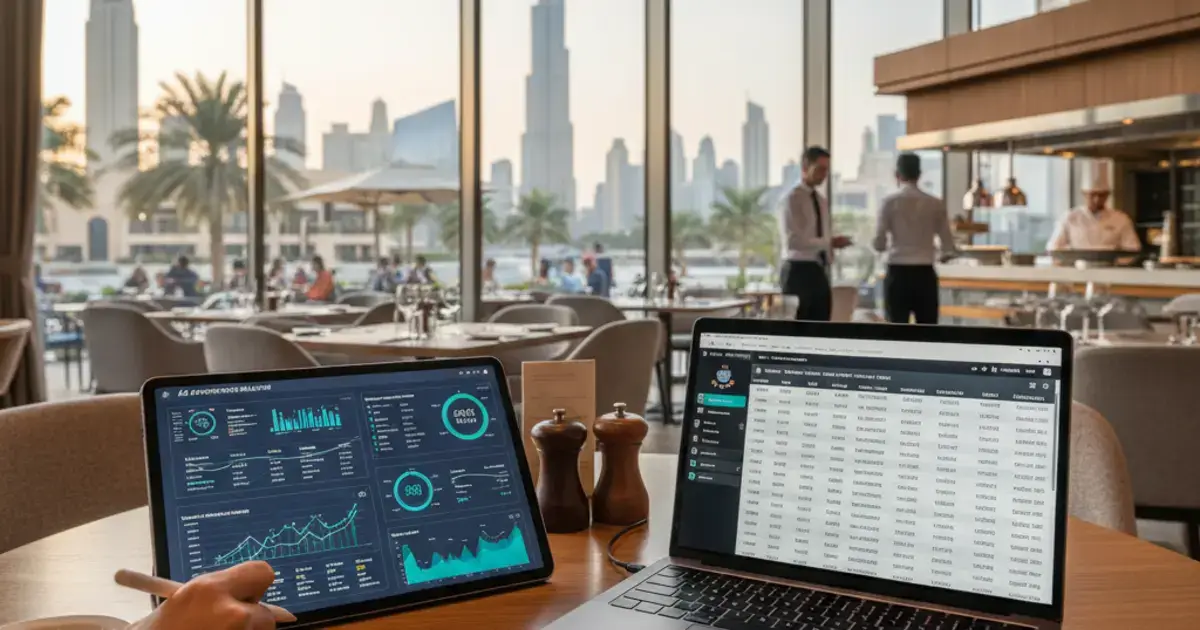

Restaurant ad ROI analysis in the UAE is all about measuring the financial returns on your marketing investments. It helps you figure out how effectively your ad spending turns into profit for your business. This involves calculating metrics like ROAS (Return On Ad Spend) and ROI (Return On Investment), which helps restaurant owners in Dubai, Abu Dhabi, and other emirates make smart decisions to optimize their ad budgets and boost overall profitability.
Here’s the Gist of It
- Effective ad ROI analysis is super critical for restaurants to survive and grow in the highly competitive UAE market.
- For accurate calculations, you need to track both online and offline conversions, including bookings, orders, and walk-ins.
- Key metrics like CAC, LTV, and AOV give you a deeper understanding of each customer’s profitability, helping you optimize your strategy.
- Common mistakes include ignoring the full customer lifecycle and failing to integrate data from various sources.
- The Dubai and Emirates market has its own quirks, meaning you need to adapt your ad strategies and constantly monitor seasonality and competition.
What is Restaurant Ad ROI Analysis in the UAE, and Why Is It So Crucial?
Restaurant ad ROI analysis in the UAE is a systematic way to evaluate how effective your marketing investments are, helping you understand if your ad campaigns are actually making a profit or just losing money. This process is crucial because in the UAE’s tough and fast-changing market, every single dirham you spend on advertising needs to work its hardest. Without this analysis, restaurants risk wasting their budget and not hitting their business goals.

In our experience, working with tons of clients in Dubai and Abu Dhabi, we constantly see many restaurateurs focusing solely on the number of bookings or orders, totally forgetting about the bottom-line profitability. But let’s be real, acquiring a high-cost client who brings in little profit is way less beneficial than getting fewer clients who have a high-profit margin. That’s why accurate restaurant ad ROI analysis in the UAE is the absolute foundation for sustainable growth and development.
“Based on observations in the Dubai market, restaurants that regularly and thoroughly analyze the ROI of their ad campaigns show, on average, 20-30% higher net profit from marketing compared to those that don’t.”
Key metrics for measuring returns:
- ROAS (Return On Ad Spend): Ad Revenue / Ad Spend * 100%. This shows how many dirhams of revenue each dirham spent on advertising brings in.
- ROI (Return On Investment): (Ad Revenue – Ad Spend) / Ad Spend * 100%. This metric is more comprehensive because it accounts for net profit, not just revenue.
Both of these metrics help evaluate the effectiveness of promotion in the United Arab Emirates, letting you quickly adjust strategies and reallocate budgets towards the most successful channels.
How to Define Key Metrics for Calculating Restaurant Profit in Dubai?
For an accurate profit calculation in Dubai, a restaurant needs to rely on a set of key metrics that go beyond just counting total revenue and expenses. These metrics give you a deep understanding of customer behavior and the true value of each visitor you acquire. Only a comprehensive approach to collecting and analyzing this data provides a full picture of your returns.
Here are the main metrics we recommend tracking:
- CAC (Customer Acquisition Cost): Total Marketing Expenses / Number of Acquired Customers. This metric shows you, on average, how much it costs to bring one new visitor into your restaurant.
- LTV (Lifetime Value): Average Check Number of Visits per Period Average Customer Retention Duration. LTV shows how much profit a customer brings in over their entire relationship with your establishment, which is especially important for understanding the long-term effectiveness of promotion in the United Arab Emirates.
- AOV (Average Order Value): Total Sales Amount / Number of Transactions. This shows how much a visitor spends on average per visit.
- CPR (Cost Per Reservation/Conversion): Campaign Spend / Number of Reservations or other Target Actions. This helps evaluate the effectiveness of individual ad channels and creatives.
- Unit Economics: Profitability analysis at the level of a single customer or transaction, taking into account direct costs, margin, and repeat purchases.
For restaurants in Dubai, it’s crucial to consider not just online conversions (bookings via website, orders through aggregators), but also offline conversions – visits driven by advertising. This can be done using promo codes, customer surveys, integration with loyalty programs, and even tracking phone calls.
How to Conduct a Step-by-Step ROI Analysis of Ad Campaigns in the Emirates?
Conducting a deep restaurant ad ROI analysis in the UAE requires a systematic approach, consisting of several key stages. Working with clients in Dubai and Abu Dhabi, we’ve developed a clear algorithm that allows us to get the most accurate data and make informed decisions.

1. Data Collection and Consolidation
The first step is to gather all data on your advertising expenses and the results you’ve gotten. This includes:
- Ad Costs: From all channels (Facebook, Instagram, Google Ads, local publications, influencers, PR).
- Number of Conversions: Bookings (online/offline), delivery orders, direct calls, unique visitors to the restaurant (via promo codes or surveys).
- Revenue from Conversions: The total amount received from customers acquired through advertising.
- Timeframes: It’s important to analyze data over a specific period (week, month, quarter) for comparison.
In our practice, we encountered a case for promoting a restaurant in Dubai where the first two months of ad campaigns showed no returns. However, after careful data consolidation, identifying the most effective channels, and adjusting offers, the dining room was fully booked from the third month onwards, showing significant profit growth.
2. Calculating Key Metrics
Once you’ve collected the data, you can move on to calculations:
- ROAS (Return On Ad Spend):
- Example: Ad Revenue = 10,000 dirhams, Ad Spend = 2,000 dirhams.
- ROAS = (10,000 / 2,000) * 100% = 500%. This means every dirham spent brought in 5 dirhams of revenue.
- ROI (Return On Investment):
- Example: Ad Revenue = 10,000 dirhams, Ad Spend = 2,000 dirhams, Cost of Goods/Services Sold for acquired customers = 3,000 dirhams.
- Net Profit from Ads = 10,000 – 2,000 – 3,000 = 5,000 dirhams.
- ROI = (5,000 / 2,000) * 100% = 250%. Every dirham spent brought in 2.5 dirhams of net profit.
3. Analysis and Interpretation of Results
The numbers you get aren’t just figures; they’re the foundation for making decisions. Analyze ROI for each ad channel, each campaign, and each target audience. Compare your metrics to previous periods and to industry benchmarks in the UAE. This helps you pinpoint inefficient spending and reallocate your budget towards more profitable areas.
“Analysis of projects in the Emirates shows that constantly optimizing ad budgets based on ROI can boost overall business profitability by up to 15% annually, even without increasing overall sales volume.”
Common Mistakes When Calculating Restaurant Promotion Effectiveness in the UAE
Mistakes in profit calculation in Dubai or other emirates can lead to wrong conclusions and inefficient allocation of your marketing budget. Based on my experience working with dozens of clients, I’ve highlighted the most common blunders that prevent restaurateurs from getting a complete and reliable picture of their returns.
Here’s a list of typical mistakes:
- Ignoring offline conversions. Many restaurants focus solely on online orders and bookings, forgetting that a significant portion of visitors come because of ads but place their order directly at the venue. Lacking systems to track such customers (e.g., unique promo codes, QR codes for menus, payment surveys) heavily distorts the picture.
- Incorrect or missing LTV tracking. By focusing only on the first purchase, restaurateurs often underestimate a customer’s true value. Repeat visits and referrals can bring in much more profit than the initial transaction. Without LTV, it’s impossible to grasp the real effectiveness of promotion in the United Arab Emirates.
- Focusing exclusively on clicks and impressions, not sales. A high CTR (Click-Through Rate) doesn’t always mean high returns. It’s crucial to track the user’s journey all the way to a real conversion, meaning an order or a visit.
- Lack of data integration from different systems. Data from CRM, POS systems, Google Analytics, and ad accounts for Facebook and Instagram should be combined to create a unified picture. Fragmented data makes a comprehensive restaurant ad ROI analysis in the UAE almost impossible.
- Inability to segment audiences and ad campaigns. An average ROI across all campaigns might hide both very successful and failing segments. It’s important to analyze returns for each channel, each ad group, and each target audience. If you’re running into Dubai ad mistakes, the problem is most likely due to incorrect segmentation.
- Overestimated or unrealistic expectations for payback periods. Not every campaign brings instant profit. Some strategies, like building brand awareness or working with influencers, might have a delayed effect. It’s crucial to give ads enough time to gain momentum, but also have clear interim KPIs.
Specifics of Restaurant Ad ROI Analysis in Dubai: What to Consider in 2024-2025?
The market in Dubai and the entire UAE has unique characteristics that significantly impact restaurant ad ROI analysis in the UAE. In 2024-2025, these features are becoming even more pronounced, demanding a deep understanding of local specifics from marketers.

High Competition in the Dubai Market
Dubai is a global culinary hub where new restaurants open daily. This means the competition for customer attention is immense. To stand out and ensure high effectiveness of promotion in the United Arab Emirates, ad campaigns need to be extremely targeted and creative. The cost per click and lead here is often higher than in other regions, which demands a more detailed approach to ROI calculation.
Impact of Tourist Flow and Cultural Specifics
A significant part of Dubai’s restaurant business targets tourists. The seasonality of tourist flow (peaking in the autumn-winter period) directly affects demand and, consequently, ad returns. Plus, you need to consider cultural and religious specifics that might influence menus, operating hours, and the choice of ad platforms.
Legal Restrictions and Advertising Platforms
In the UAE, there are strict rules regarding advertising, especially concerning alcohol, gambling, and certain food products. This can limit the choice of ad platforms and formats. For instance, alcohol advertising on social media or in public spaces is heavily regulated, requiring creative and lawful approaches to promotion. You need to stay updated on the latest legislative changes so your ad strategy doesn’t get banned.
Working with clients in Dubai, we see that the ability to adapt to these rules and find new, effective ways to increase brand awareness in the UAE is a key success factor.
Technological Advancement and Digitalization
The UAE is a leader in internet penetration and mobile technology usage. This opens up huge opportunities for digital marketing: targeted advertising on Instagram and Facebook, Google Ads, collaborations with food bloggers and delivery aggregators. However, it also means that consumers expect a high level of service and personalization, which needs to be reflected in your ad messages and strategies.
“Based on the results of launched campaigns in the UAE, we see that a deep understanding of local specifics and flexibility in adapting ad strategies allows for achieving ROAS of up to 800% in the most successful projects.”
Practical Tips: How to Improve ROI and ROAS for Your Restaurant in the UAE?
After conducting a thorough restaurant ad ROI analysis in the UAE, it’s crucial not just to know the numbers but to use them to improve future campaigns. My experience in the Dubai and other Emirates markets shows that a systematic approach to optimization and continuous testing is the key to boosting profitability. If you understand the reasons your ad strategy is failing in Dubai, you’ll be able to fix the situation faster.
Here are my practical recommendations:
- A/B test creatives and offers. Never settle for just one ad version. Constantly test different headlines, images, videos, calls to action, and special offers. Even a small improvement in conversion can significantly boost ROAS.
- Optimize your targeting. Use all available information about your target audience. In Dubai, this could be expats of a specific nationality or tourists from particular countries. The more precisely you target, the less you spend on irrelevant impressions. Study interests, demographics, and online behavior.
- Integrate online and offline data. Implement systems that allow you to link online activity with offline visits. This could be unique promo codes for online bookings mentioned during a visit, or a CRM system that records the customer acquisition source.
- Develop loyalty programs. Acquiring a new customer is always more expensive than retaining an existing one. Develop effective loyalty programs that encourage repeat visits. This directly increases LTV and, consequently, the overall ROI of your marketing efforts.
- Improve user experience. Even the most effective advertising will be useless if your restaurant’s website loads slowly, the menu is inconvenient, or the booking process is too complicated. Make sure the customer journey from clicking an ad to making an order or visiting is as smooth and pleasant as possible.
- Use retargeting. Target users who have already interacted with your ads or website but haven’t converted. Retargeting often shows significantly higher ROI because it works with an already ‘warm’ audience.
- Analyze competitors in the Emirates. Regularly track the ad campaigns of your direct competitors in Dubai and Abu Dhabi. This helps you identify new trends, successful approaches, and untapped niches you can use to your advantage.
Based on the results of launched campaigns in the UAE, implementing these recommendations often leads to a noticeable reduction in lead costs by up to 30% and an increase in conversion by 15-20% within 3-6 months.
Frequently Asked Questions
How long does a full restaurant ad ROI analysis take in the UAE?

Initial data collection setup can take anywhere from a few days to a few weeks, depending on the complexity of the restaurant’s systems. The analysis itself is usually done monthly, with strategic conclusions drawn quarterly to account for seasonality and get a representative picture.
When can I expect results from optimizing ad campaigns in Dubai?
You can start seeing the first improvements in ROAS and ROI metrics within 2-4 weeks after implementing optimization changes, especially for targeted adjustments to targeting or creatives. Significant profit growth is usually achieved within 2-3 months.
How does profit calculation differ for a restaurant in Abu Dhabi compared to Dubai?
The principles of profit calculation remain the same, but the underlying data can differ: average check, customer acquisition cost, competition, target audience demographics, and local preferences can all vary. In Abu Dhabi, the focus might shift towards the local population and business segment, whereas in Dubai, tourist flow has a greater impact.
Do I need to use third-party services for ad ROI analysis in the UAE?
Yes, for a comprehensive analysis, it’s recommended to use specialized tools: web analytics systems (Google Analytics), CRM systems, call tracking platforms, and dashboards that integrate data from various sources. This provides a more accurate and all-encompassing view of restaurant ad ROI analysis in the UAE.
What’s an acceptable average ROI for a restaurant in the United Arab Emirates?
The acceptable average ROI largely depends on the type of restaurant, its profit margins, and its business model. Generally, an ROI above 100% (meaning the net profit from advertising exceeds its cost) is already considered a good indicator. However, many successful restaurants in the UAE aim for an ROI of 200-300% or higher.
👉 Subscribe to my Telegram channel.
✉️ Message me on WhatsApp if you need clients.
📸 Follow updates on Instagram.